Showing posts with label books/magazines. Show all posts

Wednesday, 21 May 2014

Review: Albion stitch (books 1 & 2)


It's summer and harvest season and I've been too busy/tired/uninspired to blog much, but now it's high time to post the english version of my review of Heather Kingsley-Heaths books on her albion stitch. Hope you enjoy it and that it'll give you something interesting to read until I get back blogging! And, yes, I hope to have something made in this stitch to show later this summer.


Title: Albion Stitch & Albion Stitch: Book Two
Author: Heather Kingsley-Heath
Publisher and year: The Useful Booklet Company, 2009 & 2010
Number of pages: 64
  
Summary: An introduction to and exploration of a new bead-weaving stitch created by the author. The books teaches you the basics and many variations of the stitch in 19+21 projects.
Pros: Fun to learn a new, less common technique and seeing how versatile it is. Didactic and inspiring structure with chapters and moodboard pages. Diverse style of the projects and handy spiral spine.
Cons: None.
Recommended for: Seedbeaders who want to learn a new stitch. Both beginners and more experienced beaders can find fun and inspiring projects here.

Off-loom bead weaving is perhaps one of the most interesting beading techniques, or rather group of techniques as the term includes a host of stitches. Some of the stitches are very well known and spread while others are more obscure. Many basic stitches are very old and have independently developed in different parts of the world, but there are also stitches that's been created and developed by single individual in modern times. One example of the latter is albion stitch, which was created by british beader Heather Kingsley-Heath. She has presented her stitch to the beading community through two books: Albion Stitch -- An introduction to the new beadwork stitch and Albion Stitch Book Two -- Developing the new beadwork stitch. As the second books is a direct sequel to the first, I'll review them together.

The books might look little, but don't let size or page numbers deceive you -- these books are packed with technique variations and projects, but also pure inspiration as every chapter begins with a moodboard focusing on colour (book 1) and shapes (book 2). In the first book, the albion stitch is introduced to the beader. First the basics and albion stitch glossary are covered in clear illustrations. After that, you'll find eight chapters, each introducing a new variation of the basic stitch through all in all 19 projects. You'll learn how to make simple changes to the basic technique, vary the length of the stitches, stitch circular and tubular variations, make beaded beads and created curves. If you then want to take the stitch a step further, you continue with the second book, which focus on more dimensional beadwork, including beaded bezels, waves (see book cover above), cubes and containers (bowls, boxes), flowers and leaves and, finally, birds and insects.


Above you can see a (somewhat poorly scanned) picture of the first two pages of chapter six in the first book with the citrus inspired moodboard on the left and introduction to the next step, tubular albion stitch, on the right. Each chapter has its own theme, which set the mood for the projects in it. Both the moodboards and projects are very varied in style and colour combinations, which contributes to making the book such a great read. Unlike some books it's not just variations on a theme when it comes to colour and/or style -- here, you can find everything from brilliant clear colours like about and minimalist projects to neutral palettes and romantic filigree-inspired patterns. Here's pretty much something for every taste.

(In the scanned image, you can also see the clear advantage of spiral-bound books: when you open a page and put it on the table, It'll remain open. No need to hold the pages down to prevent them from slamming shut. Very handy, but not very common in how-to books.)

Now, I often say I prefer technique books to project books, but in this case, the structure of the book, where projects are used to develop the stitch step by step, is so good that I wouldn't want it any other way. On top of that, the above mentioned varied patterns and inspirational pages makes the book not just teach you something new, it also boost your creativity.

I have of cause not tested all the patterns, but so far I've found the instructions easy to follow. In most cases, the text is completed with clear illustrations (in some of the more advanced patterns, partial illustrations are used in a few cases, but on the other hand the text is clear) and the basics are explained in a very clear and educational manner. Because of the structure of the stitch, it needs a partially new terminology -- foundation row, stalk, tip, spacer row, anchor row -- on top of the general bead-weaving glossary. As with all terminology, it can feel like a lot to learn in one go, but if you follow the steps and look a the illustrations you'll soon learn/get used to it. Both books have a glossary in the beginning so you don't need to go back to the first book when reading and making projects from the second one.

So should you buy and read both the books at the same time, you might ask by now. Personally, I really liked having book 2 there when turning the last page of book 1 as the second book focused on the kind of dimensional beadwork I enjoy the most. If you're a beginner at bead weaving, book 1 can be enough, but if you're a more experienced seedbeader you'll probably like to have both books as the second book will provide you with more challenging and exciting shapes. Could an experienced seedbeader perhaps even skip directly to book 2? I don't know as I started with the first books, but as the terminology is covered in both books it'd probably not be impossible.

Regardless if you choose to read only the first book or both, though, I think you'll find it a rewarding read. There are many beadwork stitches and albion stitch was a fun technique to add to the ones I already know. It already has found its place among my other favourites, which I hope it'll now complete well. I thoroughly enjoyed the books and the techniques as an intermediate seedbeaders and I think I'd enjoy it just as much as a beginner. I was itching to pick up my needle and thread after just a few pages!

~*~

Footnote: You can buy the Albion Stitch books in some bookstores and bead shops, but the easiest way to obtain the books are probably through the authors website, Heatherworks. There you'll also find patterns and kits, some of which are fully or partially made up of albion stitch.

Sunday, 6 April 2014

Look what I won! (An embroidery WIP)


I don't always flaunt stuff I win, but this time I just had to. Partially because it's also a WIP as it included both a big book and an wool embroidery kit.

In the last minute I managed to send my e-mail and participate in a contest at the website Textil hemslöjd where I could win a book by Ulla Oscarsson that offers glimpses into the textile history of Jämtland and Härjedalen (two provinces in northern Sweden) and an embroidery kit for a big bridal cushion modelled after one made in the late 18th century in Jämtland. The book is called Kvinnomöda och skaparglädje, which loosly translates to women's effort and creativity/joy of creating.

Just have to show you a few pages of the book. It really covers everything from what fibres were used, what textiles were bought rather than made at home, what clothes people used through the ages, what textiles was used in the house, how they did laundry, what the embroideries looked like and what a bride wore. And, yes, it does include the Överhogdal tapestries.


The book with the loose banner with the title on


(Notice how the wind tried to "help" me today. Don't know what photo assistants I prefer: weather or cats...)

A very interesting book to read, even for those that like me have no connection to the region. After all, some of the history we do share in the rest of Sweden or Scandinavia -- and other parts become interesting just because of the local and regional differences.

I finished the book last night (or morning if we're being picky) so now I'm turning my focus on the second part of the prize: the bridal cushion kit.


It'll be one of my bigger embroidery projects considering it's 50 cm wide -- and the first time I work with wool. This will be a meeting between a 18th century embroiderer from Jämtland and a 21st century beader from Skåne and I will be adding my own touch to it.

That's really where I am at the moment, planning on how and where to include beads. Because it will of cause need beads! I'm not one to follow a pattern -- and everything is better with beads. Beads don't seem to have been very common in the embroidery of that time and place: I spotted very little beads in the book. It seems to have be a bit more common in other areas (like Skåne), but in general swedish folk tradition didn't really include much beading. So this project really will be a fusion between places and ages once I bead it.

One big part of the planning process is determining what beads to include: they need to match the embroidery yarns I got in the kit as I won't be substituting with anything from my own thread stash. An excuse to buy more beads? Hrmm... Maybe. I will try to do my best and see if I can't use what I already have, but this is a bit different from my usual style so bead shopping might be necessary for the best result.

Might have to make a few swatches to test bead-yarn combos first. Or just test combinations of embroidery and beading stitches. I want to do some beaded herringbone stitch. That's all I really have decided at this point.

So stay tuned to see what happens, but I warn you: I'm a slow embroiderer. This won't be done in the next couple of weeks!

Wednesday, 26 February 2014

I ♥ bokrea


The bokrea, the annual national book sale in Sweden, started yesterday. These last years I've found it quite boring because of the dull range of books on sale, but this year I've found quite a few books. Of cause, not all are that cheap so I'll have to cull a few favourites of the wishlists. (It's partially a decision between buying a slightly more expensive book or borrow it at the library, but I do love owning books both to fill the bookshelves and to not have to worry about returning them in time.)

Yesterday we had errands in Helsingborg so we took the opportunity to visit some of the shops on Väla and the book shop at Familia, but I ended up concluded the prices were cheaper online (the books on sale are mostly the same everywhere even if there are many exceptions, but the prices vary) and just bought a couple of books at the supermarket Brännborns (Ica Maxi). One fantasy novel set in our world, one period novel set in Mozambique.

I never got around to pre-order at any online shop so I'll be heading over to a couple of them soon to make sure my favourites doesn't sell out. Some already had when I checked last sunday. The punishment of procrastination unfortunately, though I did have a reason for waiting. 

So not many books yet, but it was fun to get some of the excitement over the annual book sale event back -- and I will be shopping more online. Still haven't sifted through the sale catalogue at SF Bokhandeln -- a book shop specialising in fantasy, sf, horror and comics -- so I could still have good books to discover. Fingers crossed.

Money, you say? Well... money spent on books are always money well spent, an investment. And I did save a little just for this. Still have to rein myself in though, or I'll buy way too much. It's just so tempting!


PS! Yes, I do often wait it out, trying to keep cool and hope for the 50 % off sale price offers at the end of or after the sale. It's great -- you pic up books for almost no money at all. But last year I did that and the book I really wanted was sold out by the time I got to the shop... So this year I don't want to take any chances unless with books that are of less interest. Lesson learned!

Friday, 9 November 2012

What book reviews do you want to see here?


I'm going to spend the weekend reading two swedish books on jewellery making that I'll review on my other blog (Yay, I dared to ask for review copies and got it!). That got me thinking of the book reviews I've published on this blog.

So far it's just been a few reviews of beading/jewellery-making books written in english that you've found here. Translations of newly published reviews on my other blog (where I write in Swedish). But how interesting would it be for you, my international readers, to read a review in english of a book written in Swedish? Would anyone be interested or would it be pretty useless as you might not be very likely to buy or even read those books?


And would anyone want to read reviews of my favourite american and british beading/jewellery-making books that I reviewed in Swedish ages ago, but haven't mentioned on this blog? (There's a list of all the books -- mostly in english -- that I've reviewed on my other blog here.)


And there's also another thing I've been pondering: would anyone be interested in reading reviews of books about other crafts? Apart from bead and jewellery-making books I also read books on e.g. embroidery, paper craft/art, metalwork etc. Books that I don't mention, let alone review, on my other blog, but which I enjoy and which might be of interest to some of you reading this blog.

Of cause, reviewing e.g. embroidery books -- it's mostly embroidery books at the moment -- I'd be writing from the viewpoint of a beginner, of someone who hasn't read many books and magazines that the reviewed book can be compared with. Unlike when talking about beading, a craft and art I've worked with for years and have tonnes of books and mags about. For example, I've read a goldwork book, which I'd love to write a lyrical review about, but I haven't tried goldwork. Yet.


 And a few of my craft and beading books are in languages I don't understand so reviewing them would be from a somewhat special point of view. Not that it stops me: you could just recently read my review of a french bead book. Language isn't always a problem.


Ah, the book above is danish. I've got a couple of books from that duo too that I've reviewed on my other blog. This book on making silver beads and another one on making jewellery from beach stones. Danish sorts under languages I sort of understand. Understand it well enough to read it, at least.


To conclude, I just wanted to ask you, my reader, if you like to read my reviews and if you want to read reviews on swedish beading/jewellery-making books and/or craft books that aren't bead related. Would love to hear what you think.

Thursday, 4 October 2012

Review: La broderie de perles


Title: La broderie de perles
Author: Yukiko Ogura
Publisher and year: Les éditions de saxe, 2012
Sidantal: 64
  
Summary: Bead embroidery book with floral patterns  (comes with transfer sheet) and step-by-step instructions for basic bead embroidery techniques.
Pros: Clear step-by-step photos of techniques, great photos, beautiful and varied patterns, handy iron-on transfer sheet.
Cons: Bead sizes not mentioned, you need to know the Miyuki product numbers.
Recommended for: Those interested in embroidering flowers in the form of framed bead art and/or liked japanese bead embroidery. 

Yukiko Ogura is a japanese embroiderer that have penned a number of books on different kinds of embroidery such as bead embroidery and ribbonwork. In La broderie de perles, her work is described as a creative universe where the respect for japanese embroidery tradition is united with an innovative freedom. Many of her books focus on flowers and this one is no exception.

Despite the title, this is not the french version of the book that was translated into English with the title Bead Embroidery -- something I claimed in an earlier post and have since edited. Bead Embroidery is a technique book and La broderie de perles is a pattern book -- a book full of flower patterns, intended to be displayed mainly as framed bead art, in a japanese style.

The book suites beginners (including those that doesn't speak french) as the technique chapter is so clear a image heavy, but also those who already know the techniques and want patterns to be inspired by or bead after.

As I don't speak french, this review will not judge the text in the initial chapter. This chapter briefly discusses materials (fabrics, needles, threads -- but not beads), tools and techniques for transferring patterns and mounting finished embroideries. The transfer and mounting techniques are not illustrated, something that would've been helpful for beginners. If you haven't mounted an embroidery before, I suggest you borrow a good "embroidery bible" (The Essential Guide to Embroidery [Bonniers stora bok om broderi] is one of my favourites, Needlework School [Broderiskolan] in also good -- both are out of print, though so check you library or second-hand bookshop).

The chapter is followed by a technique chapter that in large, clear step-by-step photos show how to bead stem, satin, fly, back, lazy daisy, straight and rice stitch. It also shows you how to bead roses in staight stitches and make dimensional sequin flowers. Even if you don't speak french, it's easy to follow the instructions using only the photos.


The rest of the book is dedicated to the all in all twenty projects. Most of which are mounted and framed, but which could also be adapted to e.g. bags/purses or other items. A handy iron-on transfer sheet is included in the book, which makes it really easy to transfer the patterns onto a (light) fabric.

The patterns range from smaller once with single flowers to larger bouquets.You will of cause find roses, both small cabbage roses and larger stylized ones, and fantasy flowers (as above), but also various types of flowers such as sunflowers, tulips, cosmos, cyclamen, carnation, daisy, iris etc. One pattern that differs from the rest is Symphonie de couleurs, which is stitched using clear beads and variegated embroidery floss in different colours so that the thread colours shows through the beads -- an effect otherwise mostly used in bead crochet.

There are several beautiful photos of each finished pattern, often including a close-up. You also get a coloured pattern with bead chart, making it easy to see where each bead and colour goes. The instructions include a how-to of the order in which the embroidery is stitched and which floss colour is used for the different parts (usually the colour that matches the beads so not a big problem if you can't read it), type and colour of the fabric, DMC embroidery floss colour numbers and Miyuki bead numbers.

The only thing I really could complain about is how the beads are listed. There are rarely any mention of sizes for the Miyuki beads used, only a number. That's a good thing when trying to find the exact right nuance among the hundreds and hundreds of delicas and seeds Miyuki makes, but it means having to use a list or table to find out which size bugle beads or triangles are used -- and there isn't one in the book. In other words, you have to go to this page to find out that perles bâtonnet n°81 is 6 mm and for many other sizes, you have to go through the Miyuki e-samplecards. It's easy to improvise and substitute colours, but you do want to know the size of the beads in order to follow the transferred pattern.

But that aside, this book is a pure pleasure with beautiful and varied floral motifs, clear technique instructions and handy details such as the transfer sheet and big photos. While a complete embroidery newbie would benefit from being able to read the first chapter, the rest of the book with its beautiful, clear patterns and photos can be enjoyed whether you speak french or not.

If the previously reviewed A-Z of Bead Embroidery was a book especially for romantic flower lovers, this is even more a book for those who fancy beautiful flower patterns. I would very much recommend this book to any beader, french-speaking or not, with a penchant for flowers.

Wednesday, 26 September 2012

Hurry to enter the bead book giveaway!


Just a quick reminder than Friday is the last day to enter the giveaway to win a copy of A-Z of Bead Embroidery.

If you want to learn bead embroidery or want some romantic floral patterns to be inspired by, this is a great opportunity so don't miss it! Do feel free to share this giveaway and borrow my photos to do so.
 
Click here to go to the giveaway post.

Friday, 7 September 2012

GIVEAWAY: A-Z of Bead Embroidery


In association with Country Bumpkin (publisher of "the world's most beautiful embroidery magazine, Inspirations), I'm giving away a copy of today's reviewed book, A-Z of Bead Embroidery.

A-Z of Bead Embroidery, part of Country Bumpkin's popular A-Z series of embroidery books, is a book for beginners wanting to learn how to bead on cloth, but the many inspirational projects also makes the book a good read for those already familiar with the basic techniques. The book include many techniques, including less common ones like tambour beading, padded beading and beadpoint (needlepoint with beads). The projects are divided into two chapters, one with different (often floral) motifs and one with bead fringes and edgings. You can read more about the book in my review here.

Does this sound like a book you want to read? Then don't hesiste, but fill in the bilingual entry form below for your chance to win this book. The giveaway is open to everyone, everywhere (as long as the postal service can reach you, of cause). If you can't see the form, please click here to fill it out.

NB! I'm not doing any "tweet/blog/facebook/pin this for extra chances" this time, but if you want to share this giveaway with people you think might be interested, help me spread the word, it is very appreciated! Feel free to borrow my photo above and/or in the sidebar.


Last day to enter is 28th September!


Review: A-Z of Bead Embroidery


Title: A-Z of Bead Embroidery
Author: Sue Gardner (ed.)
Publisher and year: Country Bumpkin, 2006
Pages: 128
  
Summary: Introduction to bead embroidery on cloth and canvas with many beautiful projects.
Pros: Many techniques, including tambour beading, padded beading and counted thread. Varied projects.
Cons: Very few, just miss beaded stem stitch
Recommended to: Beginners who want to learn the basics of bead embroidery on cloth and bead embroiderers looking for floral patterns to be inspired by. 


A few weeks ago, I contacted the australian publisher Country Bumpkin. The result of our mail conversation was my getting two copies of their book A-Z of Bead Embroidery: a review copy for myself -- and one copy to give away to a lucky blog reader!

To see how you can be the winner of this book, please go to the giveaway post here.

~*~

A-Z of Bead Embroidery is the 13th book in Country Bumpkin's popular A-Z series of embroidery books. The format is the same as in the rest of the series with an introduction to the materials and tools used, followed by a section of basic techniques with step-by-step photos and then finishing with projects showing how the techniques can be used. Here and there in the book, you can find inspiration photos of bead embroideries from the publisher's world-renowned embroidery magazine Inspirations. The book also includes little boxes with everything from practical hints to information about the history of beads, birthstones, beadworks, colour symbolism etc.

All books in the series are spiralbound, which is very handy as it makes it easy to lay the book open on a table or sofa while embroidering.


 The focus of the book is on bead and sequin embroidery on fabric, tulle and canvas/aida. The kind of bead embroidery where the background fabric is part of the design unlike bead embroidered jewellery, where the embroidery is often done on a special backing that is fully covered with beads. The embroidery designs in this book are intended as wall hangings, embellishment etc. The basic bead embroidery techniques are the same no matter what you want to make, but I want to point out that this is no jewellery-making book.

The techniques covered in the book includes, as already mention, both the most basic -- often a couple of different ways to stitch single seed and bugle beads, beads on a row and sequins -- and less common techniques that aren't very often covered in other bead embroidery books. This includes counted embroidery such as beadpoint and embroidery on aida, tambour beading with a tambour hook and padded beading. As these techniques aren't found in many other (beginner level) books, it would have been interesting to see a few more variations, but then again, the book is mainly meant to be an introduction. The only basic embroidery stitch I really missed was stem stitch -- it's such a simple stitch, but so striking when done with beads, making it perfect for beginners.

Over half the book is devoted to the 31 embroidery projects, which are divided on two chapters with the first one focusing on different patterns/designs and the second on bead fringes and edgings. Almost all the designs in the first chapter are floral. As the designs are created by eight different embroiderers, the styles and techniques are very varied. The projects include beadpoint, flower beads on aida, tulle embroidery, sequined motifs, embellished silk prints and -- my personal favourite -- beading on lace motifs. Some of the projects include step-by-step photos while others are in text only. Seed beads are the main material used, but larger beads such as fire-polished, bicones, leaf and flower beads, hearts, rhinestones, lucite flowers and sequins are also used, mostly as accents.

Six of the project in the designs chapter include other embroidery stitches such as ribbon, chain, padded satin, split and back stitch. Stitches that it's assumed you already know. If you aren't familar with them, you can find instructions online (for free) or in books like The Essential Guide to Embroidery.

The last chapter, Fringes and edgings, focus on designs -- the majority by Jane Davis -- rather than basic patterns, which makes the chapter a bit different from many books introducing the reader to beaded fringe. All the twelve fringes/edgings combine seeds and larger beads such as druks, fire-polished, bicones, daggers, leaf beads and gemstone chips. The are probably designed mainly for bags, wall hangings and such, but some could probably be adapted for jewellery too.

To sum up, A-Z of Bead Embroidery is a both informative and inspiring book for those interested in beading (and stitching sequins) on cloth and canvas. The many projects fit both beginners and those already familiar with bead embroidery, perhaps looking for new projects or just inspiration. When I blogged about being interested in this book, on comment was that it probably would suit me, considering my penchant for flowers and the romantic. Others could also appreciate the book -- the techniques chapters are universal -- but if you like flowers, you will probably enjoy this book more and get more out of it.

Thursday, 30 August 2012

Review: One Bead at a Time

Earlier this summer I began thinking about posting my book reviews not just on Manekis Pärlblogg, but also here. In English. So here you are, my book reviews -- now also available in English. First book to be reviewed is Robin Atkins' One Bead at a Time. And as usual when I start writing, it never ends. I don't do short reviews.


Title: One Bead at a Time. Exploring Creativity with Bead Embroidery
Author: Robin Atkins
Publisher and year: Tiger Press, 1997
No. of pages: 56
  
Summary: Book on improvised embroidery and the positive effects of creativity.
Pros: Unique approach compared to other books on the subject. Encouraging and full of food for thought.
Cons:
Recommended for: Those interested in the liberating and healing process of creating with your own hands. 

In 1997, american bead artist Robin Atkins wrote her first book, One Bead at a Time. After several printings, she decided not to print any new editions but instead publish it as a e-book (pdf format), available for free at her website. To download you own copy, click here.

One Bead at a Time is a different kind of bead book. It doesn't focus on techniques and projects -- even if a stitch guide and practical advice on supplies are included -- but on the creative process and also the therapeutical properties that can be found in creative arts and crafts. It might sound lofty or spaced out when I put it like that, but this is very much a down-to-earth , practical guide. A perfect little book for those interested in exploring their creativity and feeling by creating art using beads, needle and thread. Even if you prefer other beading or jewellery-making techniques than bead embroidery, the thoughts on how to overcome creative blocks and freeing your creativity could be inspiring and useful.

The book has two pervasive themes. The first part of the book is all about finding your own creativity and start creating. Atkins wants to fill you with a "just do it" attitude, encouraging the reader so he or she can break through that all too common wall of self-critisism, doubts and negative thoughts that keeps us from indulging in creativity and creating art. The permissive approach is important in the book: it's ok to hoard beads that won't be used, it's ok to just look at the treasures, it's ok not to plan ahead, it's ok not to feel pressured into selling, it's ok to stitch however you want. There is no wrong way to bead. The author wants creativty beading to be without demands or rules: don't overthink it as it can create blocks and self-critisism, just sit down with some beads, a scrap of fabric and needle and thread -- and start beading. Now. Focus on the process, not the result -- that will come by itself.

Atkins encourage a unbridled creativity and freedom to dare create freely, without limitations as ideas of right or wrong in the choice of materials, techniques or colour combinations -- controlling the work can suffocate the inspiration. Dare is an important word as it's very much about daring to go outside the safe but narrow framework that's been building up around us as we grow up. It's about following impulses instead of rules on what's appropriate, correct, tasteful or safe. For what comes uncensored from the heart is always beautiful as it's inspired and by focusing on the heart's voice we can break through negativities that block our creativity.

The second theme of the book is healing, meditative and therapeutical effects of the spontaneous or improvised beading. How the not preplanned work that lets the heart and soul decide can create a harmonious flow or release emotions. How the creative process can be used to work through difficult events in life. Examples mentioned in the book are transitions in life, the death of a family member, depressions and more. The book doesn't claim this is an easy process and it is sometimes about recognizing blocks and working through them. It might sound very theoretical or spaced out, but it's not -- many,who began to bead (or crochet, embroider, knit, paint etc) during a tough period in life, can tell about how the hobby became a life line.

The book contains many photos or improvised beadwork, made by the author herself or by her students. A number of the works are mentioned in the text, discussing the origin and process behind them. There are stories about students who were helped by this creative process and Atkins also dare to expose herself, telling personal stories from her own life and how the improvised beading process helped her. These concrete examples makes the book an encouraging, practical guide to the creative process. The book is based on real experiences and a genuine wish to spread the ideas of the ability to, through beads, express yourself directly from the heart and soul -- and the positive, healing power that can be found in such beading -- to beaders of all skill levels. The book wants to inspire and it does.

Saturday, 23 June 2012

Is it possible...


...to have too many books on a subject? I've spent the beginning of this weekend seeding my latest book purchace (Goldwork by Hazel Everett and A-Z of Stumpwork). Both include a few bead embroideries/embellishments (or designs that would look good with a touch of beadwork), which made me think of starting a new bead embroidery project. And then, at the end of the A-Z book there was a page with other books from the series. Which included A-Z of Bead Embroidery. "That might be an interesting book. I should add it to my wishlist just in case or at least check it out."

Now, do I need another bead embroidery book? I have three. Three very different ones: The Art of Bead Embroidery by Heidi Kummli and Sherry Serafini, Designs for Bead Embroidery by Kenneth King and Bead Embroidery: The Complete Guide by Jane Davis. (I also have the free download of Robin Atkins' One Bead at a Time, but I haven't read it all yet...) Isn't that enough? Of cause not!

First of all, many book have different profiles, styles and ideas. My books span over bead embroidery jewellery (Kummli and Serafini), bead embellished clothes and home décor (King) and beaded "traditional" embroidery stitches (Davis). Bead embroidery is such a wide subject that even three books can't encompass all faces of it. Also, I''m always looking for new ideas, inspirations, applications and points of view.


So what bead embroidery books can be found on my too long craft book wishlist? Below is a list of books I for some reason or another have added to the list. Some I'm just dying to buy, others I know very little of and just added because the seemed more or less interesting.

The bead embroidery book wishlist


Dimensional Bead Embroidery by Jamie Cloud Eakin: interested in her jewellery style and I've seen this stitch index (pdf) for her two books, which looked promising. A complement to my Kummli & Serafini book.


La broderie de perles by Yukiko Ogura: Have seen a few pretty pics from the pages of this book. Lots of flowers, which I like. I do believe this is the french version of a japanese book that's called Bead Embroidery in the english version. The english version appears to be out of print as I can't find it in my usual online book shops so that's why I'm listing the french version eventhough I don't speak french. (You don't always need to be able to read a craft book to enjoy it and find it useful -- I have books in japanese and dutch too.) Update: Ignore that -- I was wrong. Have since bought this book and seen a preview of the english book -- which I know can find again -- and it's not the same. This is a great book, though, no doubt about it! So glad I couldn't resist the urge to buy it.


Bead Embroidery by Yukiko Ogura: Another book by the same japanese embroiderer. This one focuses more on techniques while the french book is all about flower patterns. A book that's gotten many good reviews and based on what I've seen in her other book, I'm sure it's very much worth buying one day.


Bead Embroidery by Valerie Campbell-Harding & Pamela Watts:  Found it while stumbling on an embroidery technique called "trapped beads". Description says it also includes machine embroidery. Not that I touch a sewing machine if it can be avoided (always have preferred hand tools in all materials), but it's interesting and not that usual in books [I've blogged -- on my other blog -- about machine bead embroidery if you want to learn more.]


Bead and Sequin Embroidery Stitches by Stanley Levy: A book mentioned on Saturday Sequins in her bead embroidery resource post (good read if you want to give bead embroidery a try!). Why not expand and learn some more about sequin stitches/techniques too?


A-Z of Bead Embroidery: Ah, yes, this is the book mentioned in the beginning of this post. Flipped through the preview at the publisher's website and it seems of some interest.


Bead Embroidery Stitch Samples by CRK Design and Yasuko Endo: I've only seen the cover of this book. Maybe it's not that interesting, maybe it's just like Jane Davis' book. But I like the cover. [UPDATE: I found a short preview at the Interweave store -- it isn't released yet, by the way.]


Beaded Dimensional Embroidery (Milner Craft Series) by Helan Pearce: Have I seen pages from this book? I must have since it's included in my list, but I can't pinpoint exactly what it was that made me list this one... (Both Pearce and Davis seem to be in the A-Z book too.)


 Finishing Techniques for Bead Embroidery Projects by Robin Atkins: Always useful to learn and consider how to finish a project properly. And I want to do wall hangings or something, which needs good framing/finishing/suspension and that's not always like finishing jewellery. (This book can be bought directly from the author. No ISBN = not sold in book shops.)


And that's my list. At least my list as it looks on the evening of June 23rd. Of cause, this list only includes bead embroidery books. I also have books that partially includes beads that's on my wishlist, but for this post I drew the line at bead embroidery only titles.

*

If you have a good bead embroidery book that you think I should add to the list, don't hesitate to comment (preferrably with a reason for why it's so good). Or if you have read one of the above books, I'd love to hear what you thought of it: would you recommend it or should I buy something else? All and any tips and/or comments more than welcome!

Thursday, 21 June 2012

Upphlutur


I mentioned in the Helsingborg post that I had a find to share. Nothing big and not a thing. It's a magazine article find.

It all started because few stores in Helsingborg are open on a Sunday so we went to Pressbyrån to look for a copy of the new rose-themed issue of Hemslöjd. I told my sis to keep an eye out for it while looking through all the magazine shelves, commenting and looking for something of interest. My sis found it first, but what she picked up and showed me was the mag next to it, norwegian Bunad (issue 2-2012). I'm not sure why she picked it up to show. Maybe she wanted to say "look, a norwegian hemslöjd magazine" or "look at those girls on the cover" (in colourful and patterned folk costumes) or "look at that price". Either way, I took the copy, flipped through it -- and there it was! An upphlutur.


I've never seen icelandic folk costumes (Þjóðbúningurinn) before and this particular one is very different from the scanian and swedish folkdräkter and bygdedräkter I've seen. (Not just because the other scandinavian/nordic costumes are regional while the icelandic ones are national.) I really liked the simplicity of the black-and-white upphlutur. And above all I loved the embellishments. At first I thought it was like goldwork, metallic threads embroidered onto the cloth. It didn't look like plain embroidery floss so my guess was goldwork with silver threads. Then I looked closer and saw that it was in fact silver filigree (real, handmade silver filigree) stitched to the bodice. Two of my favourite things in one: metalwork and embroidery!


Look at that!


The mother inherited her dress, which has vermeil filigree instead of just silver, from her grandmother, who in turn was given it in the 1920's (so it's really old). At that time this type of upphlutur was relatively new. It was designed by Gudmundura Thoroddsen in the early 20th century. The upphlutur itself was originally part -- or more precisely the "undergarment" -- of another folk costume, the faldbúningur (see this photo). When it was warm the faldbúningur could be worn without the jacket and from that the upphlutur was developed as a folk costume in its own right. The colours can vary. The bodice is often black but can also be e.g. blue or red. As you can see, different types of aprons are also used and the embellishments varies. The cap that goes with the dress is called skotthúfa or, in english, icelandic tail cap.

Of cause I can't show you the whole article (already this much is probably a stretch). There's more pics and information in the magazine and while it doesn't go in to any depth, if you want to see better pics -- and, if you understand norwegian, want to read the whole article -- you might want to try and get a copy. It costs 89 SEK or NOK, though.

You can read more about the icelandic folk costumes at e.g. The Icelandic National Costume Board  and Wikipedia. More pics of upphluturs can be found on the Icelandic National Costume Board website, Flickr and by image googling.

Myself, I'm starting to think about embroidering filigree and wirework on cloth now.

Tuesday, 5 June 2012

Bead and jewellery making book reviews


I'm sitting here -- after a short working day (2 hours) -- and waiting for my book order to arrive. It feels like ages ago that I ordered them (last week)... No books in the mail today, but perhaps tomorrow?

Anyway, since I'm thinking about nothing but books -- the ones I bought and the ones I want to buy -- I got the idea to make a short list of beading and jewellery making books I've reviewed on my other blog. Mostly books in english, but also swedish, danish, dutch, french, japanese books can be found in my collection -- eventhough I don't even speak all those languages!


List of reviewed bead and jewellery making books 2008-2011

Books listed by name of author. Click on the title of each book to go directly to the review post in question. Of cause all reviews are written in Swedish; if you want, you can translate them using Google Translate.

~ * ~


I also read magazines, though with a few exceptions I have found that I prefer books, but Belle Armoire Jewelry is so far the only mag I've gone as far as reviewing. Partially because that's one of the few mags I had several recent issues of; reviewing a mag based on one issue feels somewhat unjuste and reviewing a mag based on what it was like two or three years ago when I subscribed or regularly bought copies is even more unfair and gives a dated and perhaps even wrong view of what the mag is like today (and tomorrow).


I haven't reviewed any books in a while now. Since the books only are ones found at the local library -- not that many of interest -- or bought when my budget allowed such luxuries, the number of reviews I can make are very limited. The first couple of years I simply reviewed books from my bookshelf, but now I've already reviewed most of those. Well, at least I'll hopefully sometime during this week get one book that'll be perfect to review on the blog. After that I'm not sure how many more book purchases my budget will allow (seeing how I want to buy supplies too, not just books).


PS! Would you be interested to read my future reviews here, in english, too? Just let me know if you do and I'll include them here as well.

Tuesday, 10 April 2012

Testing PicMonkey


A few days ago I heard about online photo editor PicMonkey. I looked around, "doodled" a bit and tested the different features. This is the first pic I've done using it that I've also saved. Not great, but it does display one feature I really like and missed in Picnik.

PicMonkey is created by some of the people behind Picnik so if you like/liked Picnik, you might want to check out their site. It's still being developed and new features are being added now and then. At the moment all features are free (even the royale ones that will probably be like Picnik Premium features in the future -- read about that here). Haven't had time to play very much with PicMonkey, but so far I like it. It has all the things I like/liked about Picnik. And a few more. The only thing I don't like is that you don't seem to be able to upload and save pics directly from e.g. a Flickr or Picasa account.

For this one I've used two textures, one of them being a photo I've taken. I like that I can use my own textures. My "texture" is the back of a Jules Verne novel, a swedish edition of L'île à hélice (eng. Propeller Island, also published as The Floating Island and The Pearl of the Pacific; sw. Maskin-ön). The house (which looks more american than swedish, don't you think?) can be found in Båstad. You can see the original pic in this post.


UPDATE: Ok, now I actually read the text on the photo used as a texture and have to correct myself. It isn't  Propeller Island, the only Verne book I own, but another of his novels that I borrowed from the library. Very similar design of the covers, but two different books. The photo is in fact the back cover of a swedish edition of La Chasse au météore (Sw. Guldmeteoren, Eng. The Chase of the golden meteor). Nothing else.

Monday, 31 October 2011

If I had a birthday wishlist...


 ...I know one thing I'd put at the top (apart from money to buy beads): a Paperblanks journal. Unlined of cause: I always prefer to both write and sketch on unlined paper. They are so gorgeous. Expensive, but gorgeous. If you haven't seen or heard about them you really ought to check them out. Last time my sis and I went to a book shop that carries these, we spent ages just drooling over them and touching them. We didn't really have the money to buy any so after a while we had to pull ourselves away from the shelf before succumbing to the urge to purchase one or two or...

But here's the thing: I also know that when I buy an "eye candy" journal or notebook I desire, I don't dare using it because then it will be all "spent up". It's like with special beads, I want to save them for something special -- and end up never daring to use them. Just having them sit there waiting for the perfect idea, worthy of these special things, and never really believing that what I do at the moment is special enough. Using them for something mundane would be sacrilege! Still, I covet those journals so bad. And I do think I've learnt to accept that notebooks are meant to be used, no matter how special or trivial the notes are. It's not desecration to write on a pristine, white page of an expensive notebook -- even if it almost feels that way sometimes. I'm using them, which is what they were made for. It's silly to buy a notebook and then buy some more cheap ones as I can't write in the expensive one...

(And, no, I don't write a personal journal. I want the book as a sketch book and to jot down ideas and texts for stories etc.)

So I do hope I get at least a little money from my parents and grandma so I can buy one without feeling guilty for not saving the money for more important things. I know a lot of stuff that I probably should prioritize over a luxury journal, but sometimes you need something beautiful to brighten up your day.

But something I also really hope to be able to buy soon is books. I love reading books, both fiction and non-fiction (history, science, cultural geography, beading, jewellery making, embroidery etc). If you're curious, part of my vast wish list can be found here. It's pretty much focusing on how-to books rather than fiction (so very little fantasy) and because it's a british shop, there are no Swedish titles. My unabridged book wishlist is many times longer. In fact, it's not even one complete list, but comprised of book reviews I cut out of mags and papers, bookmarks on my browser and the Book Depository wishlist -- so not even I know how many books there's really on it! (The one below is: not a cheap embroidery technique to learn, but I really like some of the modern goldwork. Feels luxurious to work with threads like that too.)


I'm not expecting to get a lot of presents or money for my birthday, but I'm hoping it'll be enough to buy a book or two -- and hopefully a journal too. Knowing myself, though, I think it's much more likely I buy books and supplies than a journal, no matter how many years I've wanted one, as beads and books feel more useful than a blank journal. But if I ever get a real job and real income one day, I know a Paperblanks journal will be one of the first things I'll buy.


PS! Yes, I stole those photos of the Paperblanks website. Hope they don't mind it too much... That's actually not the journal/notebook I've been oogling the most, but I love the colours of the books in the Romantic Sensibility collection.

Wednesday, 19 October 2011

Went shopping again


Yes, I know I'm on a tight budget and shouldn't shop, but you just can't pass up an opportunity to get to buy a handmade gräddbulle (as I mentioned here). Gräddbullerian and Accessorize are by far my two favourite shops among all the new ones at Väla (sorry, Bites & Bottles). Apart from gräddbullar, the only thing I was thinking of buying was a bottle of gesso and some stickers so I can make more MOP etchings. But then of cause I had to go by Pressbyrån and check out all the mags. They don't seem to carry any of the beading or jewellery making mags anymore, but I can find other craft magazines and creative reading. This time I picked up an issue of Hemslöjd.

I discovered Hemslöjden, the magazine that has now become Hemslöjd, more or less by accident. I was given a whole bunch of back issues by a woman that was moving to a new home. Keep or donate to charity she said. I read them and kept them all. Even if I hesitated at first. Could this really be for me?

To understand why I felt like that, you have to understand both what hemslöjd means and the age in which I grew up.


Saturday, 8 October 2011

Book finds -- jewellery inspiration


Yesterday, my sis and I went down to the village as we both had mail to collect. As we had time and the weather wasn't too bad we also went by the pharmacy and, as it's just around the corner from that shop, the library. Of cause they we selling old books and redundant copies so we got stuck there for a while. Not that many great finds, but I did walk away with a few books. One of them was Jewels of the Pharaohs: Egyptian Jewelry of the Dynastic Period by Cyril Aldred.

I can't say Ancient Egypt is one of my main source of inspiration, but I have found inspiration from there before (even done an egyptian revival-inspired jewellery set once) and a book on jewellery is always a book on jewellery. Even if it is old and have those typical 70's colour photos.

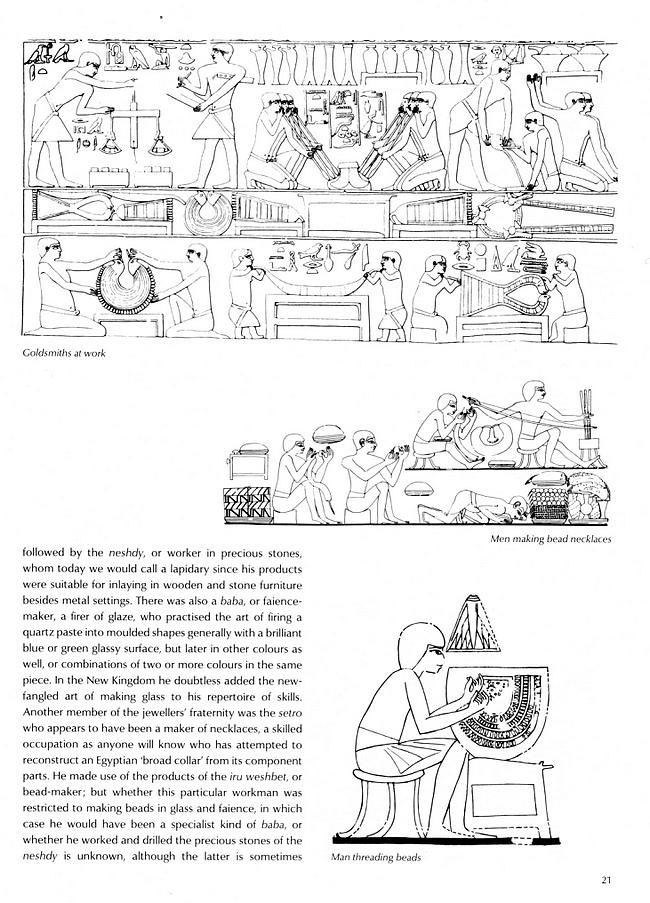
Haven't read it yet, but have flipped through it and found some inspirational -- and impressive -- jewellery. It's not just eye candy: the book covers bead making, jewellery techniques, history, symbolism etc on around 40 pages. You can e.g. learn that a bead maker was called iru weshbet and that it isn't known whether the Egyptians knew how to draw wire.

Flipping through the colour plates, I kept thinking I wanted to see more close-ups of the clasps and bead and that there was a slightly annoying lack of measurements. Because nowadays I don't just want eye candy for inspiration, I want to know how something is made. Techniques, materials, what the back looks like, what details and mechanisms (e.g. clasps, hinges, fasteners). Everything.


This page show one of the pieces that caught my eye, a floral circlet belonging to princess Khnumet who was buried in Dahshur (the crown above it was also hers). It's not something I'd immediately class as egyptian if I hadn't seen it in this book. Seeing it, I keep thinking it might be an inspiration for a piece made in wire crochet, either a circlet or a necklace. You can click on the image for a close-up so you can see more of the details.


Here's another page I quite liked. The top image is of goldsmiths, known as nuby, at work. Below that is two images of male jewellery makers making bead necklaces and collars. The guy below almost seem to have a modern day bead board. Apart from the nuby (goldsmith) and iru weshbet (bead maker), there was also the baba (faience maker) and neshdy (lapidary) involved in the jewellery making. [Googling it, I also found that the skilled collar stringers were known as seti nub.]

So now I have "new" book that includes two of my favourite subjects -- cultural history and jewellery/beads -- to read. Or rather look at as it's mostly pictures. Hopefully, I'll both learn something new and find jewellery inspiration in it.
Related Posts Plugin for WordPress, Blogger...