Saturday, 13 August 2011
Bead blog recap weeks 31-32
I'm back to my normal schedule of writing on Manekis Pärlblogg since August and after these two first weeks, it's time for the first recap/review since my summer break. This time you can find everything from brooch bouquets and flower weaving to contest tips and how to attract readers to your tutorials. And of cause, mentioning the rusty black patina that you can see in the jewellery components above.
Friday, 12 August 2011
Synergy, collaboration and creating components
This week I mentioned, in the comment to a blog post, that I'd be more interested in selling beads and components made by me than selling finished jewellery. One of the reasons being that I really like to see how others would use my components in designs and in ways I wouldn't have thought of myself.
Now, so far I haven't found my style or even my material for launching any kind of art bead or handmade component line. But I have felt something similar in a completely different venue. I have an account over at ColourLOVERS. I've had it for some time and made a couple of palettes, but lately I've become more active there and also discovered the template maker, where you create pattern templates for others (and yourself) to colour. While still learning how to use, I have managed to make a few patterns.
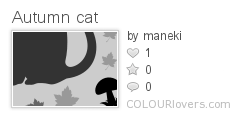
One of the patterns can be seen above (click on it or on this link to view the whole patten). I call it Autumn cat. I'm still a beginner and it might show. Anyway, I wasn't fully pleased with it and it wasn't better when I couldn't colour it in a good way (according to my self-critical eye). But then something happened: others began using it and colouring it -- and they made it look better than I managed to make it. That was fun. Not just flattering because they choose to play around with my template out of all those available, but also fun when seeing how they chose to use it.
Before that I made another cat pattern. In just two colours as I didn't understand how to change the colour settings. It has been used in two palettes.
And this is kind of a good illustration of why I want to make components and not just finished jewellery. I like seeing someone else take something I've made and finish it in his or her own way, adding elements I wouldn't have thought of using myself. It's like one of those stories where one person begins to write or tell and then hand over it to the next, who does the same thing, and in the end they have a story no one would've been able to write on their own, but only through their collaboration. Take away one person in the chain and replace him or her with another and you would've got another result: each chain in the link can add unique elements that alter the finished product. Whether it's a collaboration with two or more people working side by side or more of a rely race where one person takes over from another, I find this very interesting and inspiring.
Thursday, 11 August 2011
Glass frosting: etchant vs. tumbler
I've got a tag on this blog that says "etched glass/stone", though actually it has come to include not just beads, pendants, cabs and glass stones I've frosted using etching cream but also glass frosted in a tumbler. I've been thinking about doing a comparison between these to techniques for creating frosted/etched surfaces on -- primarily -- glass. I'd love to try sand blasting too (small scale, using Sand Etch), but right now I only have experience using the two other methods.
Before I begin discussing the pros and cons of the methods, I'd like to add that I'm still a beginner when it comes to using etching liquids as well as a tumbler. In fact, the tumbler is not even mine so it's my sis who's in charge of it, I just pitch in every now and then with my views and ideas. But so far, this is what I've learned:
Safety and usage
Etching liquid etches not only glass but also skin so you have to wear protective gloves and think about what kind of tools to use etc. It's also said that vapours can cloud mirrors and damage glass in storage. Add to that discussions on whether it really is a safe chemical or not. Besides, even if it claims to be non-toxic, it doesn't mean it's safe if used without care!
The tumbler on the other hand contains nothing caustic. You should of cause not inhale the abrasive powders (if using that rather than e.g. sand) and if tumbling crystal glass in particular, you should dispose of the dross wisely as it can contain lead. The waste can also clog the pipes so it shouldn't be poured down the drain.
The etchant shouldn't be stored or used cold as it forms crystals that has to be removed before etching my heating and stirring the liquid.
Etching cream can also get stuck in holes as well as nooks and crannies on the surface, which are hard to clean. When it dries, it could just as well be cement. That's how hard it can be to remove.
Personally, I find etching creams more messy than a tumbler, but if working with an etchant you just dip the beads into that would probably be easier.
As for the saftey of the younger members of the household, I'd say it's a bigger problem if a kid or pet walks into a room where you have etching cream/fluid on the table than a tumbler.
Time
It takes perhaps 15-20 minutes according to the instructions for the etch cream/fluid to great a good finish while it takes hours to acheive a nice texture in a tumbler. However, especially if using cream rather than a dipping fluid, you have to apply the etchant to each piece individually and make sure it's covered. With a tumbler, you just chuck it all in and let the machine do the work. Likewise, you don't have to thoroughly clean the tumbled glass piece by piece as you have to with an etch cream (you must remove every trace of the chemicals). You have to check on it at intervals to stop the process at the right point, but that goes for both methods.
While i takes weeks to tumble raw stones into shiny, polished cabs and pendants, it is a matter of hours or at tops a couple of days to frost glass. In fact, if you just want to burnish the sharp edges instead of getting the matte finish, it can take as little as 30 minutes.
The barrels for the tumbler comes in different sizes and also the tumblers themselves are made for different volumes, so you can choose a bigger solution for tumbling larger quantities at once.
Finish/texture
With an etchant, you can vary the depth of the etching by letting it work for a longer or shorter periods. Just like with the tumbler. However, with a tumbler you can choose between different abrasive and thus create everything from fine to coarse textures. There's room for experimentation.
With and etching cream you can use stencils, resist gels or stickers to create patterns or motif on the surface, which I doubt is possible with a tumbler where the water and mechanical abrasion would wear down the resists.
There's also one more important difference: the etchant with etch the entire (uncovered) surface while the tumbler usually leaves the recesses untouched. See the fifth picture in this post: notice the oily AB finish still there in the crevices while the raised areas are matte. Here, the alternative to the chemicals would be sand blasting, not a tumbler, if looking for an even matte finish.
Materials
The etchant I used (by EtchAll) works on "soft" glass, but not on Pyrex/borosilicate glass. According to Rings & Things it works most of the time on japanese seed beads, but the coatings seem to weaken the etchant, make it less effective. It also works on some stones, e.g. agates and onyxes, but not on all -- and you might not know which ones works until you test it yourself. Some stones with etch terribly unevenly, with both shiny and matte areas, which looks really bad.
For the tumbler, different abrasive have different efficiency: it shouldn't be too hard to be able and grind down most surfaces, hard or soft.
Economy
To be honest, I haven't really done any calculations. However, I will offer a few points to keep in mind.
First of all, the tumbler isn't cheap and the abrasives will need to be replaced as they're being used. On the other hand, a tumbler can be used for many more things than the etchant. You can work-harden and polish metal, tumble stones, ceramics, polymer clay etc and creating hematite like oxidized finishes on metal. The tumbler is supposed to use a moderate amount of electricity even if it's on for several hours for each batch.
The etchant can be reused many times, while the abrasives for the tumbler, mixed with glass residue, can't be used for a new batch. Buying etchant is cheaper than the starting cost for buying tumblers and abrasives, but I haven't calculated the cost per piece. You can often use plastic tools and protective gloves you already have at home.
Conclusion
Both methods have their pros and cons. Which one you prefer depends both on what you want to be able to acheive in terms of textures and finishes or what materials you want to work with. I use both etchants and tumblers and don't see myself abandoning one for the other. They do a similar job, yes, but in different ways with different results -- and I like them both!
Buying a tumbler isn't cheap and so it might be a decision that needs to be thought over more than buying a jar of etchant (a small jar isn't too expensive) just to test it. You probably shouldn't buy one unless you actually plan on using it more than once or twice. If possible, ask if you can borrow someone else's tumbler for a trial run or buy a used one if you aren't sure of whether you "need" a new tumbler of your own. If you work with metal, make beads or wants to get into lapidary, it might be more useful than if just etching a few glass pebbles once a month or perhaps even less as you can take advantage of the versatility of it then.
The third alternative: Sand blasting
Another alternative to potentially harmful chemicals is sand blasting. There are special set-ups for small items and home studios, such as a Sand Blast kit. I haven't tested it myself, but hope to be able to do it in the future. It could be an alternative to etch creams and a complement to a tumbler as it can achieve even matte finish on textured surfaces and you can use resists unlike in a tumbler.
Your turn
Do you use tumblers or etchants -- or sand blasting for that matter -- to give glass and stone a nice texture or etch motifs? Please, feel free to share your experiences and add to the list of pros and cons.
Footnote: For our experiments, we have used EtchAll etching cream (but not Dip 'n' etch) and a Lortone tumbler with commercial abrasives.
Monday, 8 August 2011
A tiger lily in autumn
Well, it's been a chilly (below 15 °C), rainy day which started out ok but ended with thunder and hail, so maybe it isn't strange than I rather think of warm autumn days, saturated with colour. And, anyway, I know it's not uncommon for beaders as well as others to be inspired by the coming season rather than the current. Even by those of us that don't bead to sell and therefore have to be ready with an appropriate collection when the season begins. Though, I'm not sure it was thoughts of autumn that (consiously) inspired this bracelet. Rather it began with a thought and a bead and then the other colours where chosen to work with it.
I made the bracelet for Heather Powers' Inspired by Nature challenges -- which you should read about if you don't already know about them -- the theme of the week being tiger lily. When I first read that my crystal chili pepper flower beads came to my mind. The chili pepper finish is kind of a shiny slightly reddish amber. It's a coating on clear glass which means it can have a charming variation in depth. The colour (to some extent) reminded me of the orange lily and the shape echoed the petals of the tiger lily.
As I only had four flowers, I also added a few similar beads in crystal brandy and then crystal apricot 8 mm daggers for leaves. For the findings, I wanted something that enhanced the sparkling autumn colours so I chose bright copper plate and solid copper (the head pins).
The delicate chain with the elongated links was twisted and folded double. Both to form a more substantial chain and to give an illusion of some sort of intertwining vine or some such. It was a bit tricky, not least since the links are so elongated that the twist ends up slightly too loose for a charm bracelet. But I still like it.
As so often it ended up being a pretty dainty bracelet (this time partially due to bead shortage, but it's also my style) and I think it might look good worn together with a couple of other autumn themed bracelets. What do you think?
Friday, 5 August 2011
Violet drops earrings
And for those of you not interested in kitties, here's a pair of earrings I made up a few years back. I had had the idea for some time before actually trying it out. It all began when I saw Lea Rose Nowicki's Looking Great Coming and Going earrings in BeadStyle. The thing that made her earrings stand out was that she'd added dangles not only to the stud itself, but also to the nut. I thought it looked fun.
Looking at it, I also remembered how people using earrings -- I don't myself, haven't pierced my ears -- often complained about losing the nuts and therefore didn't particularly like stud earrings. Well, I thought why not take Lea's idea but instead of using two seperate dangles, make just one than extended from the loop on the stud to the loop on the nut. That way it'd be impossible to lose the nut. Sure, it can still fall of the post, but if it does you still know where to find it.
I never have much chain laying around so I thought this one could make due for my experiment. Then I just added some drop beads to keep it simple. I'm sure the idea could be developed and evolve into nicer designs than this one.
The kitties have names
Last time I showed photos of the kittens, they didn't have any names yet. Well, not too long ago we managed to name them at last. As usual we rarely use traditional cat names and we also tend to name one cat after others before them. Sometimes there's also a theme when naming a litter. I'm saying that to prepare you for the slightly unorthodox names.
Jisse is named after Isse (Svartis), who died about a year ago. He's very active and full of energy. Especially early in the mornings when he likes to attack my feet, scratch my legs and just generally run up and down on me while I'm trying to sleep.
Jinja is the only girl. She's named after Jin-Jin (Jindy) and her mother, Ninjis (Ninja). She's a little more careful than Jisse and the smallest of the three. She likes to sleep really close to you in bed -- and now she's old enough to do that without me being afraid of crushing her in my sleep...
Julle is named after a cat we had many years ago, Mulle. He had long hair and of the three, Julle is the one with the fuzziest fur. Julle is actually a real human name or at least nickname in Sweden. He was the one to open his eyes the last and that probably contributed to the fact that he's the shy and hesitant one as he spent more time not seeing what happened around him. He's got a white tip on his tail to go with the spot on his nose.
As you see they all got names beginning with a j. Jinja because she's named after Jin-Jin and then it was used as an abbreviation of junior in the other two names. It was either j as in junior or m as in mini, both used by us when naming a cat after one that's passed away.
Monday, 1 August 2011
My aliases online
So I just joined Pinterest and I've been tweeking my Twitter page. I have a really lame Twitter accounted that's pretty much never been used other than to follow a couple of people/shops and I've never even tweeted once. I just haven't gotten into it, merely stood by the side when others have had fun. Kind of like at the amusement parks where I've always been too chicken to go with my friends on most of the rides. And so I join Pinterest, yet another facet of social media, without having a clue how to get started with it. I mean, it's not as I need another place to be social at (I'm not a social person and rubbish at socializing really) and spend more time at the computer to keep updated. But I did it. And I'm thinking of becoming more active on Flickr, which I've mostly used to publish pics to be hotlinked in forums or challenge entries (at the Art Bead Scene group mostly).
But that's not really what I wanted to post about. What prompted this post was that all this made me think about how to be recognized online as I started to join communities and websites before I began thinking about having one common online alias, one online persona. How can someone I "meet" on Flickr know that maneki-neko girl is the same person as Vildros on Etsy or kristina on UKBF? I like being somewhat anonymous and have used different aliases so separate the beader from the fantasy reader and so on, but at some point I feel I should tie some of my accounts together so people know that behind the different names is one person, Maneki (which pretty much is my online beading persona, I rarely use my real name online anymore).
Most of the time my alias nowadays is Maneki --capital m or not, it varies -- but I still use some different names you might know me under. Here are a few sites where you can find me under different names. Links go to my profile page on each website.
On forums like Smyckestillverkning iFokus, Nätverket Inspira etc, I'm Maneki.
Coming up with a good alias is hard, which I discovered when I joined Pärlplatsen, one of the first online communities I joined. I couldn't think of even one good name and in the end I gave up and wrote down Maneki-neko girl because it was something I'd come up with one day after fallen in love with the japanese maneki-neko lucky cats. Anyway, that stuck, but because it was so long many abbreviated it, calling me m-n or maneki. And nowadays Maneki is pretty much my beading alias -- eventhough the name makes no sense to anyone who understands japanese. One several other forums I joined as a newbie beader I didn't use that alias, though, but instead went with the thuroughly unimaginative kristina (most of the time not capitalizing my name).Not only is it my first name, but it's also a very common name in Sweden so it's easy to be confused with another Kristina or Christina.
But that's not really what I wanted to post about. What prompted this post was that all this made me think about how to be recognized online as I started to join communities and websites before I began thinking about having one common online alias, one online persona. How can someone I "meet" on Flickr know that maneki-neko girl is the same person as Vildros on Etsy or kristina on UKBF? I like being somewhat anonymous and have used different aliases so separate the beader from the fantasy reader and so on, but at some point I feel I should tie some of my accounts together so people know that behind the different names is one person, Maneki (which pretty much is my online beading persona, I rarely use my real name online anymore).
Most of the time my alias nowadays is Maneki --capital m or not, it varies -- but I still use some different names you might know me under. Here are a few sites where you can find me under different names. Links go to my profile page on each website.
Blogger: maneki
ColourLovers: maneki
Etsy: Vildros (no shop, just shopping)
Flickr: Maneki-neko girl (Katten & Draken is my old account)
Pinterest: ManekiBeader
Twitter: ManekiBeader (used to be ManekisParlblog; haven't tweeted even once)
Uk Beaders Forum: kristina
On forums like Smyckestillverkning iFokus, Nätverket Inspira etc, I'm Maneki.
*
Coming up with a good alias is hard, which I discovered when I joined Pärlplatsen, one of the first online communities I joined. I couldn't think of even one good name and in the end I gave up and wrote down Maneki-neko girl because it was something I'd come up with one day after fallen in love with the japanese maneki-neko lucky cats. Anyway, that stuck, but because it was so long many abbreviated it, calling me m-n or maneki. And nowadays Maneki is pretty much my beading alias -- eventhough the name makes no sense to anyone who understands japanese. One several other forums I joined as a newbie beader I didn't use that alias, though, but instead went with the thuroughly unimaginative kristina (most of the time not capitalizing my name).Not only is it my first name, but it's also a very common name in Sweden so it's easy to be confused with another Kristina or Christina.
Subscribe to:
Posts (Atom)